
Kansas City Resident Lookup Records
Official records do not form one current resident list. A county assessor can connect a named owner or tax contact to a parcel. A recorder can show that a named party transferred an interest on a date. The voter route can return a matching registration status, and Missouri Case.net can show a person as a litigant. Vital, business, and license records answer still different questions. The strongest Kansas City resident lookup compares the type of evidence, the county, and the record date instead of treating any one result as proof of where a person lives.
| Record | What It Can Confirm | Custodian or Route | Access Boundary |
|---|---|---|---|
| Parcel card | Named owner or tax-contact relationship to a parcel | Jackson Public Property Access Portal or the relevant county assessor | Public fields, but a mailing address can differ from the situs address |
| Recorded instrument | Grantor, grantee, legal description, and recording date | County Recorder of Deeds index and office | Jackson images begin online in the early 1960s; older material uses microfilm |
| Voter status | Matching registration status and local election details | Missouri Voter Outreach Portal or local authority | Exact-match lookup; protected addresses stay protected |
| Court docket | Public litigant, case, date, and status information | Missouri Case.net | A docket is not a complete public case file |
| Vital record | Qualifying birth, death, marriage, or divorce event | Missouri DHSS, recorder, or circuit clerk | Copies have record-specific eligibility and fee rules |
| Credential or entity filing | Professional status or public business association | MOPRO and Missouri Secretary of State records | Useful corroboration, not current-residence proof |
Use the record that best fits the question already known. An address often starts with the assessor. A court case number starts with Case.net. A historical death question may belong with the state vital-record route or an older death index. When a result has no county or date in common with the other evidence, leave it unconfirmed. Note: A property mailing field and a physical parcel address are separate fields and should be labeled that way.
Kansas City Records Need County Context
Kansas City crosses Jackson, Clay, Platte, and Cass Counties. That geography changes the assessor, recorder, election authority, and circuit-court route for an address. A Kansas City mailing address is not enough to select an office. Jackson uses the 16th Judicial Circuit, Clay the 7th, Platte the 6th, and Cass the 17th. Missouri Case.net provides the common index, but its court and location selections still matter when narrowing a result.
County boundaries also change the property trail. Jackson's online recorded-document inventory reaches the early 1960s, with older documents on microfilm. Clay states online records from 1968 and indexes them by name rather than location. Platte and Cass have online entry points, but the research did not establish their exact digitization cutoffs. Keep the county name beside every result. It prevents a same-name hit in one county from being confused with a person connected to another Kansas City address.
Case.net for a Kansas City Name Check
Case.net is Missouri's statewide court index for participating courts. It can be searched by litigant name, filing date, case number, or scheduled hearings and trials. Choose the county, court, or location when that information is known. A name search identifies litigants, not every person mentioned in a file. Victims, witnesses, children, and protected people may not display, so an empty name result is not a finding about a person's residence or history.
| Litigant Name | Use the full spelling when known, then compare county and case style before accepting a match. |
|---|---|
| Filing Date | Narrows a search to a known time period when a name alone is broad. |
| Case Number | Provides the most direct route to a specific docket and its court division. |
| Hearings & Trials | Searches scheduled events, with court and location selections available to narrow the result. |
A public result may show the case number, style or parties, case type, filing date, court location, docket events, hearing information, and disposition or status. Exact fields vary by division and case. Those are the useful items to save for a verification note.
- Case number and court division
- Party style and spelling used by the court
- Case type, filing date, and current status
- Relevant docket-event dates and scheduled hearings
Myth: One Kansas City Resident Match Proves Identity
A full name is not identity proof. Build a short comparison set: exact name, middle initial or suffix, approximate age or year of birth, county, address, date, a relative or spouse when a public record supplies it, and the type of record. Then compare like with like. A deed party should fit the parcel's legal description and date. A voter match should fit the county and district. A Case.net result should fit the case style and court before it is connected to the name-verification process.
The property card has a local trap. Jackson separates the parcel's physical location from the mailing address used for tax communications. The mailing field can be a correspondence contact, a prior owner, or another authorized recipient. It is a lead, not a statement that a named person currently lives at the parcel. Missouri's exact-match voter tools can also reject a nickname or alternate spelling, so search the registered form of a name and preserve the portal's original field labels.
Verify a Kansas City Resident Across Records
Use a record trail that ties a name to a place and time. Start with the correct county assessor when an address or owner name is known. Record whether the result identifies an owner, tax contact, situs address, or mailing address. Cross-check an exact voter-status result if the person can lawfully use that route. Next, search Case.net with the same spelling and county. A recent record from two independent custodians is stronger than a single old instrument.
- Identify the county for the address and save the parcel number, legal description, and the exact name shown by the assessor.
- Check a matching voter status or permitted election record through the correct authority, keeping protected-address rules in mind.
- Search Case.net by the name and likely county, then compare the court, date, and party style with the parcel trail.
- Use the recorder, circuit clerk, or DHSS only for the record or certified copy actually needed, rather than asking an office to identify a person.
- Docket
- A court's running list of events in a case, such as filings, hearings, and dispositions.
- Index and image
- An index points to a record and its basic fields. An image is the underlying scanned document, which may have different access rules.
- Certified copy
- A copy issued or certified by the custodian for a record-specific purpose. It is different from a search result or plain web printout.
For an older address, trace the parcel and legal description through recorded grantor and grantee entries, then use directories, maps, obituary material, or probate only as dated cross-checks. The historical volumes are better handled through the Kansas City city directory collections than by treating them as current-address evidence.
Exact Voter Details for Kansas City Residents
The Missouri Voter Outreach Portal asks for First Name as registered, Last Name, date of birth in MM/DD/YYYY format, last four SSN, and county. The Kansas City Election Board's local lookup uses first name, last name, and date of birth for Kansas City voters in Jackson County. Its notice says the lookup is not stored or shared and may return registration, ward or precinct, sample ballot, and polling-place information. Neither route is a public block browser.
The Kansas City Election Board voter-status lookup illustrates the name-and-date matching route used for a status check.
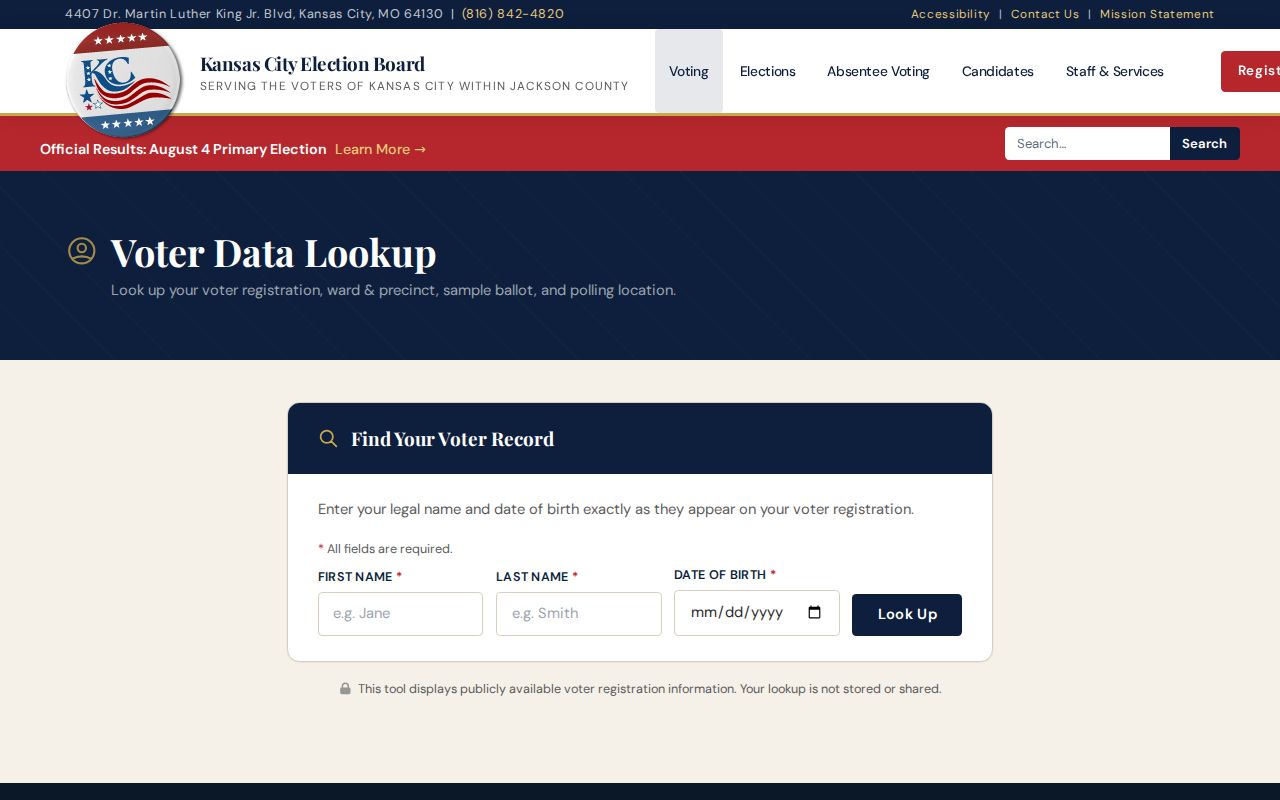
The screen supports an exact-match check, not a broad name sweep. RSMo §115.157 permits specified voter-file fields through the proper process, but full date of birth, Social Security numbers, unique identifiers, and protected addresses are not general public results. Note: A no-match can reflect a protected address, name variation, status change, or the wrong county.
Vital Records for Kansas City Residents
Missouri separates the event record from the copy a requester may receive. The Department of Health and Senior Services issues statewide certified birth and death copies, plus statewide marriage and divorce statements. Local public health agencies may handle some short-form birth or death certificates. A county recorder issues the original marriage certificate and a circuit clerk issues the certified divorce decree. Statewide birth and death registration starts in 1910, while statewide marriage and divorce reporting starts in 1948.
Use the Missouri DHSS applications and forms index to check the current request route and eligibility before sending an application.
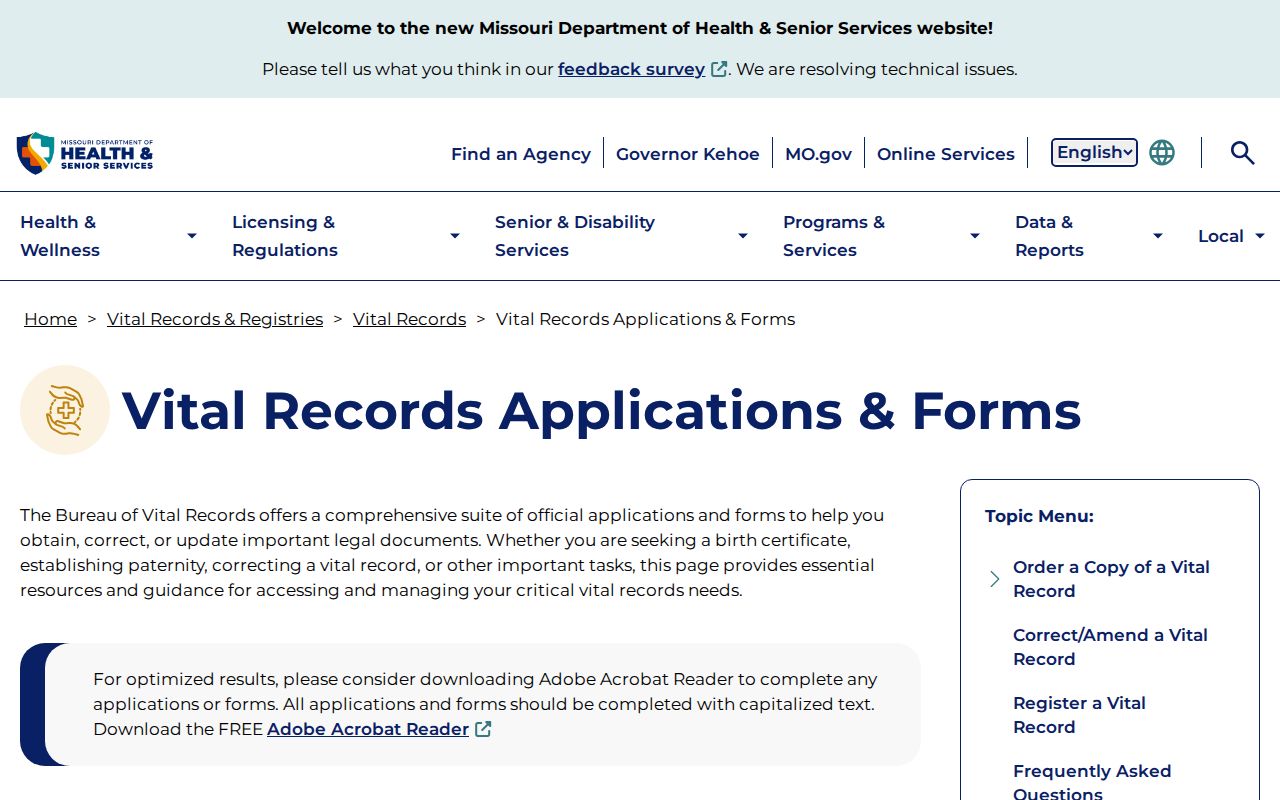
Certified copies require the applicable direct and tangible interest or authorization. Mailed applications require notarization, photo ID or two alternate IDs, and DHSS estimated mail processing at about four to eight weeks during the research period. Missouri's 50-year rule under RSMo §193.245 opens older death records subject to current statutory limits. A state marriage or divorce statement is not the original marriage certificate or court decree.
Kansas City Credentials Can Corroborate a Name
Public entity and credential databases can help distinguish two people with the same name. The Missouri Secretary of State Business Search supports business name, registered agent, name availability, and charter-number modes. Results can lead to general information, contacts, filings, copies, and certificates. A registered-agent address is an entity contact, not proof of a person's home.
Missouri's MOPRO license search supports license number, business name or address, Missouri SOS, and FEIN modes, with active and nonactive filters. Capture the board, license type, number, status, displayed issue or expiration information, and source date. A credential may confirm that a named person holds a license, but a listed address can be a principal office, mailing contact, or board address. It should never be relabeled as a current residence without a separate public record.
Insider Tip: Kansas City Court Images
An E-CASE marker means that a case file is electronic. It does not mean every document is available through a remote click. A hyperlinked docket entry can indicate an attachment, while an entry without a link may have no document or may be unavailable to that user. The file viewer places the case number and style above the document and groups material by category.
For an accessible record that is not available online, use the case number and division to ask the circuit clerk or court administrator for the appropriate copy route. Public users may need court staff to log them on at a courthouse terminal for file-viewer access. Confidential material, including sealed, expunged, juvenile, protected, and certain mental-health records, does not become public because a docket exists. This is the practical limit behind a one-person search: an index tells you where to ask, not what an office may disclose.
Kansas City Resident Lookup Privacy Limits
Missouri Safe at Home provides eligible participants with a substitute address accepted by state and local government, courts, voter registration, schools, libraries, social services, and law enforcement. The actual address is not something a public directory should try to reconstruct. Court-protected voter addresses, driver information, utility data, sealed court material, and nonpublic association records also remain outside a normal public search. A missing address can be a lawful protection, not a problem to solve.
Lawful use. Use public records for personal, lawful research and respect protected information. RSMo §565.225 does not permit using a record to follow, threaten, repeatedly contact, or harass another person.
If a property, voter, court, or vital record is wrong, ask the custodian about its correction, amendment, or redaction process. A narrow Missouri Sunshine Law request should identify an existing record, date range, and desired format. Under RSMo §610.023, a custodian must respond as soon as possible and no later than the end of the third business day, or explain a delay or denial with its legal basis. Note: A records request cannot require an agency to create a new answer or disclose an exempt record.