
Kansas City City Directory Collections
Kansas City directory research starts with a holdings question, not an assumption that every year has a free scan. The Kansas City Public Library routes local-history work through KC History and Missouri Valley Special Collections, while published finding aids identify several Kansas City runs. Those guides give a useful year spine, but they do not prove that a particular reel or bound edition is waiting at one local desk. Confirm the edition, whether an address section survives, and whether the item is on microfilm, in print, or in a licensed database before making a special trip.
| Collection | Years | Where Held | Access |
|---|---|---|---|
| Local directory finding-aid runs | 1865 to 1901; 1870 to 1935; selected print through 1987 to 1988 | KCLibrary/Missouri Valley route; St. Louis County Library guide | Confirm the exact local volume or reel before relying on it |
| NARA city-directory microfilm guide | 1929 to 1931 | National Archives guide | Use the guide to identify the target reel and edition |
| Gale directory-reel guide | 1928 to 1933, including North Kansas City in 1933 | Gale guide and the holding archive | Verify reel availability with the archive |
| KC History and Local History Index | Current online index and digital gallery | Kansas City Public Library | Search a name, place, or topic, then request the non-circulating original |
| UMKC LaBudde and JCHS material | Collection-specific coverage | UMKC and Historic Truman Courthouse archives | Finding aids, reading-room rules, or an appointment may apply |
The access chain is deliberately mixed. Start online with the Local History Index, ask Missouri Valley staff to verify a directory or reverse section, then use an archive request, microfilm, or a library-card database when a web search stops. Jackson County Historical Society accepts appointment research requests, while its donated collections are a separate archive rather than a county records counter. Note: Record the source, edition year, and format beside every transcription so a later reader can repeat the search.
Kansas City City Directories at KC History
KC History is the practical front door for historical Kansas City research. Missouri Valley Special Collections is non-circulating and combines archives, a digital gallery, and a Local History Index with directory, newspaper, map, yearbook, and genealogy leads. The public collection page does not publish a complete directory-by-directory list, so a name or address request should include spelling variants, the approximate year, and any ward or neighborhood wording seen in another record. HeritageQuest is also offered through the library and requires a library card, making it a useful companion for released federal census schedules.
See the KC History and Missouri Valley Special Collections portal before contacting staff about a specific Kansas City directory volume.
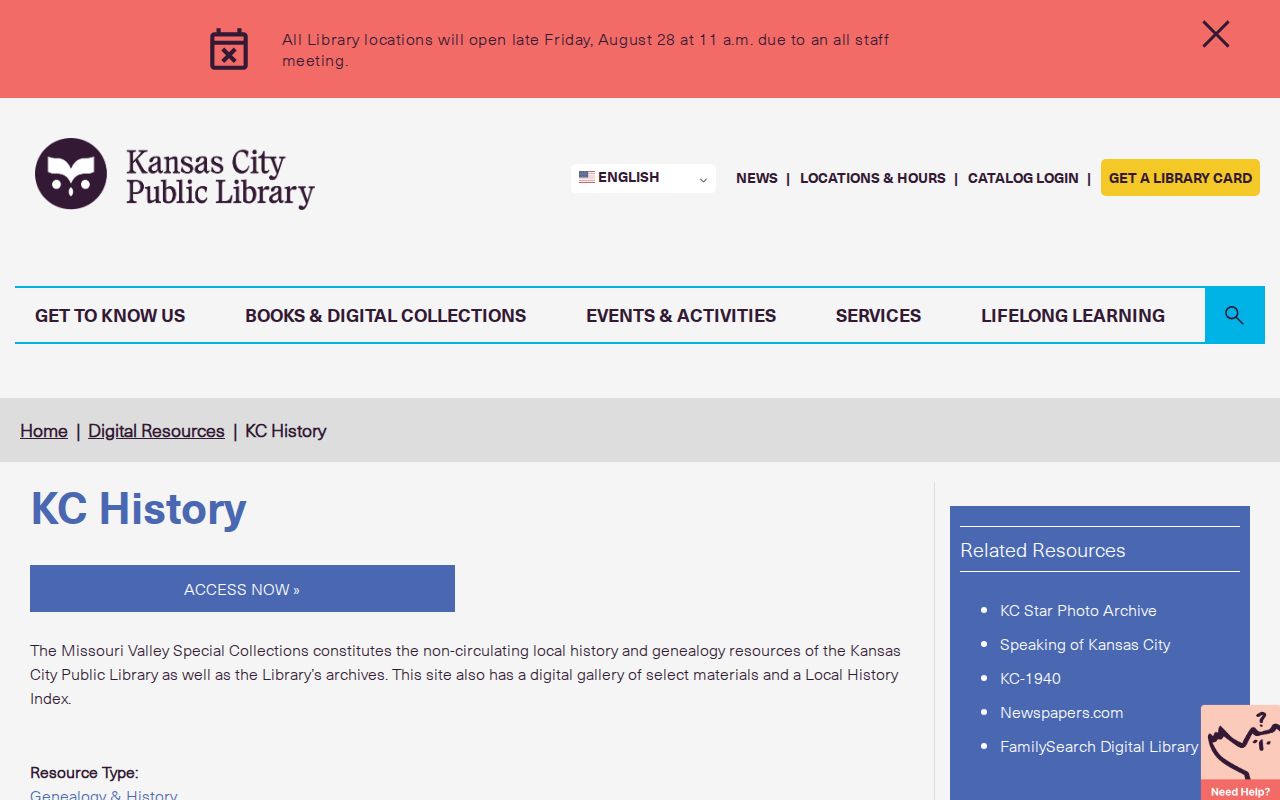
The collection landing page shows why a directory search often branches to an index entry, a newspaper, or a map rather than ending with one alphabetical listing. Preserve the original directory language when it differs from a modern neighborhood name.
Kansas City City Directory Years and Reels
The verified year clues form a useful timeline. A Missouri city-directory guide identifies Kansas City microfilm examples beginning in 1865, later material through 1935, and selected printed examples through 1987 to 1988. NARA identifies Kansas City directories for 1929 to 1931, and the Gale reel guide lists 1928 to 1933. These sources are finding aids, not a guarantee that every annual issue is available in Kansas City. Ask for the precise edition and check neighboring years if a person seems to disappear.
- 1865 onward: directory finding aids identify early Kansas City microfilm leads.
- 1928 to 1933: Gale reels and NARA's 1929 to 1931 guide mark a concentrated group of searchable targets.
- Later printed examples: selected years include 1916, 1945, 1947, 1950 to 1951, 1953, 1955, and 1987 to 1988.
A household can be missed because of a middle initial, a shortened given name, a spouse notation, a changed street number, or a different ward. A gap may also be a publication issue rather than evidence of a move. The modern address-by-address path is better handled through the Kansas City street address directory, while old volumes supply the dated household layer.
Reading Kansas City City Directory Entries
A directory line should be copied before it is interpreted. Capture the title page, publisher, edition year, exact surname spelling, initials, family notation, address, and every mark beside the name. Kansas City research did not yield a publicly accessible local sample-entry image or abbreviation key, so no symbol should be expanded from memory. The wording may record an address, a historical business association, an occupancy mark, or a widow notation. It does not prove present residence, legal title, or the full makeup of a household.
| Volume and year | Copy the Kansas City title and edition year exactly, then note the archive or reel that supplied it. |
|---|---|
| Alphabetical headword | Keep the surname, given name or initials, spouse notation, and widow or deceased notation as printed. |
| Address line | Record the house number, street, apartment or room if shown, plus any neighborhood or ward wording. |
| Occupancy notation | Read any mark only with the volume's own key; it is not proof of a legal interest in the parcel. |
| Work or business line | Transcribe the historical occupation, employer, business name, or office address only when the entry prints it. |
| Cross-check | Test the entry against a deed, census, obituary, permit, Sanborn sheet, or another directory year. |
Later volumes can include an address-side section, but its availability must be confirmed for the specific year. The address entry and alphabetical entry should agree before a household is attached to a building.
- Criss-cross directory
- An address-ordered section that can connect a street number to a listed occupant or business before the alphabetical volume is checked.
- Householder index
- An index arranged around the named household contact, which may not include every person at the address.
- Abbreviation key
- The volume's own explanation of initials and marks. Photograph or transcribe it before interpreting a line.
Kansas City City Directories Aren't All Online
Missouri Digital Heritage describes city directories as annual name, address, business, and date resources with searchable text fields where material has been digitized. Its public city-directory collection lists Hannibal and St. Louis, not Kansas City. That absence matters. A broad web search can miss the Kansas City item because the useful copy is a physical volume, a microfilm reel, a licensed library database, or an archive request. The right response is to switch access channels, not to treat a no-result screen as proof that the directory never existed.
Myth: Kansas City historical directories are not all online. Use the online index to find leads, then verify the exact volume, reel, or archive route with the holding institution.
Visit Missouri Digital Heritage's city-directory collection page to see the digitized-collection scope that creates this Kansas City gap.
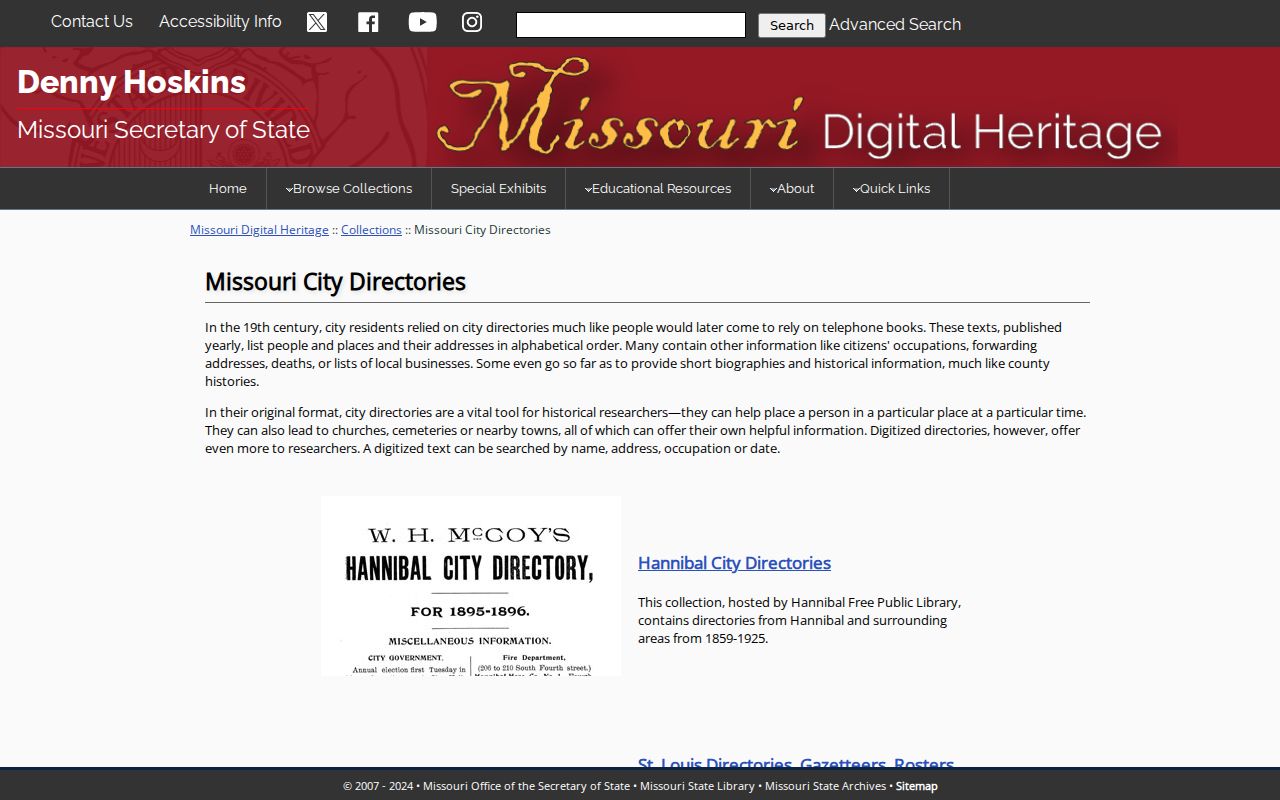
The screenshot supports a simple access decision: Kansas City research may need a library or archive request even when another Missouri city's directories are available online.
Kansas City Directory Address Variants
Reverse or criss-cross sections bridge an address to a historical listing. Start with the year and street range, capture the listed name and any notation, and then look for that name in the alphabetical portion of the same volume. Repeat in an adjacent year before deciding that an address change is a move. Publication lead time, apartment numbers, initials, spelling, ward language, renamed streets, and renumbering can all create a false break in the record.
Kansas City has an added geography problem. Historical ward and neighborhood language may not align with a current ZIP code or modern enumeration geography. The 1925 UMKC atlas uses neighborhood plates and records building footprints, land ownership, and transport routes. A map can help tie an old street range to a block, but it does not name every household. Note: Keep the printed address and historical geography together rather than replacing them with a modern label.
Trace Kansas City City Directory Households
A careful household trail moves through dated sources rather than treating one entry as an answer. Begin with the first confirmed appearance, track the name and address through available volumes, and compare each result with released census schedules. Census access follows the federal 72-year rule, and its ward or enumeration-district geography can differ from present boundaries. Directory entries often fall between census years, which is their strongest use. For a person found in an old volume who needs a modern confirmation, use the separate Kansas City resident lookup path instead of extending a historical entry beyond its date.
- Find the first Kansas City directory entry that clearly matches the name, street, and family notation.
- Follow the person forward and backward through neighboring directory years, preserving changes in initials, street numbers, and wards.
- Check the address-side section when the volume has one, then verify the name again in the alphabetical section.
- Pair the run with released census schedules, using the historical enumeration district rather than a current ZIP label.
- Test a disappearance against a deed, newspaper, obituary, probate file, map, or another directory before drawing a conclusion.
Obituaries, probate, and cemetery material can close a historical trail, but exact local obituary-index and newspaper-year coverage was not published in the inspected library pages. Ask Missouri Valley staff which title or index covers the target period. A directory listing can identify a lodger, caretaker, office, owner, or one household member, so it should remain a dated evidence category rather than a complete person profile.
Kansas City Archives Beyond Directories
The historical shelf is spread across several institutions. UMKC LaBudde holds the 1925 Kansas City Atlas and wider primary-source collections. The Library of Congress has Kansas City Sanborn material, including 1896 volume 2 and examples from 1895, 1905, 1906, 1909, and 1951. Sanborn sheets describe lots, structures, materials, and streets, not a full list of people. Jackson County Historical Society adds donated photographs, maps, letters, diaries, business ledgers, certificates, and rare books that may provide neighborhood context around a directory address.
The Historic Truman Courthouse history page introduces the site used by the Jackson County Historical Society archive.
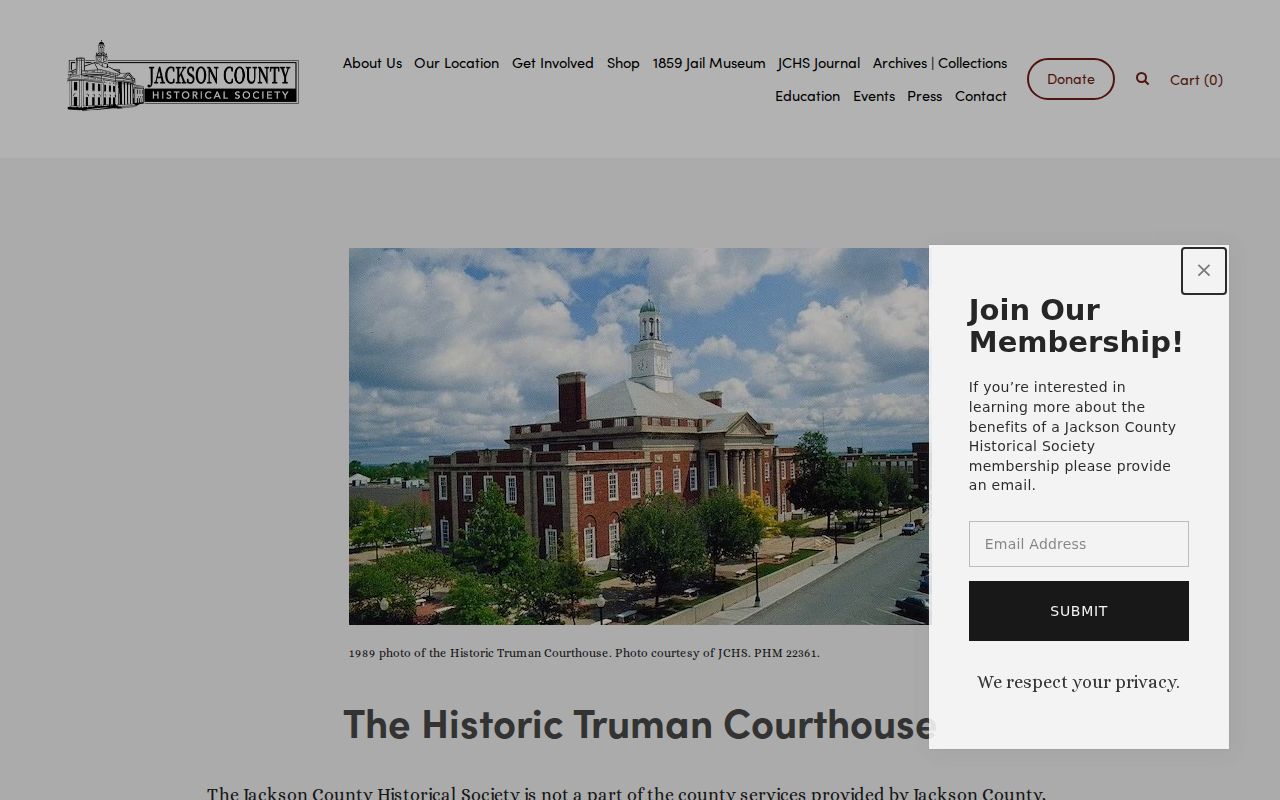
JCHS research requires an appointment and does not accommodate walk-in research. In-person research is free, while document copies are listed at $0.25 per page and digital documents at $1 per page, with separate image rates. It is a repository and referral service, not the Jackson County Recorder.